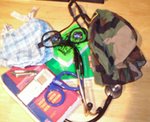
Typical Wound Rounds
It was one of those typical wound rounds days at our VA Hospital. We made our (the complete vascular surgical team) over to the long-term care wing of the hospital to do our weekly check of patients who didn't have formal vascular clinic appointments or who were bedridden with chronic wounds. The mid-level practitioners would put names of patients on a list at the nurses station for us to check. The patients who were ambulatory or wheel-chair bound would return to their rooms so that we could check them as we made our way down a T-shaped hallway with two long wings. The entire process generally took from 2-4 hours depending on how many patients to see and how extensive the wounds were and what care was needed.
The hallways
Most of the rooms down these hallways were semi-private (2 vets to a room) with a ward (4 vets to a room) at the proximal ends. At the end of the hallway were the private rooms for those vets who were in isolation for infections or for those who were too loud or ventilated and would not be amenable to sharing a room with another vet. The rooms at the far end of the hallway, though private, had views from the window that rivaled any 4-star hotel. They overlooked the front grounds of the hospital and the baseball diamond. Flying in the breeze was the state flag, the POW-MIA flag and the flag of the United States. The entire VA complex sat upon a hill that overlooked the surrounding town and mountains in the distance. No matter what time of year, the views were spectacular and I always paused to admire nature's show for these men who had given so much.
Chronic Wounds
We made our way from room to room. Many of these patients were post toe amputations and needed wound checks. Others were diabetic with foot ulcers from poorly fitting shoes or injuries that they could not feel and thus the wounds had become infected. Many of the vets were long-time smokers and diabetics with peripheral vascular disease from smoking and neurovascular disease from their diabetes. Some were despirately trying to "keep their feet" while others had both lower extremities amputated starting with the toes, then the feet and finally the leg above the knee. With each room change, there came a new challenge or a new evaluation. We removed dressings, evaluated vascular supply and made recommendations for each patient. With each week, I grew to know these patients and to learn to predict whether the wounds would heal, or an intervention was needed, or progression to limb amputation. Sometimes it wasn't wonderful to tell a patient that he would lose his foot but a good amputation with a well-healed stump could mean a return to ambulation and increased freedom. It was the progression of things each week.
Moving toward the end of the hall
This week, we decided to divide the duties with the interns doing post op checks and the more senior residents examining those patients who needed evaluation for possible surgical interventions. I elected to see the last two patients who were bedridden and in isolation for MRSA (meth resistant stap aureus). I knew that these guys had extensive wounds that would take some time inspect, debride and re-dress. I loaded my pockets with enough bandages for the dressing change and left my coat on the cart outside of the door as I donned the yellow isolation gown, a mask , gloves and shoe covers. I greeted my first patient and set to work removing the old dressings. We had ordered that dressings be changed every six hours on this patient but it was clear that his dressings were being changed daily instead of three times daily. How was this wound going to heal? It's the wet to dry dressings that debride the wound and help to clear the necrotic tissue that would promote healing. I chatted with "George" as I completed the inspection and dressing change. I left my initials, the date and time on the outside of the dressing. If this was still here in the AM (I had planned to stop in early and check), I would be writing an incident report. If George was to keep his leg, this dressing needed to be changed. For George, a very pleasant gentleman who was post stroke, this was limb salvage.
The last room
I moved into Fred's room after I cleaned up and washed my hands from George's wounds. It was now well past dinner time and the sun was low in the sky. Fred's bed was facing the beautiful setting sun. Fred had congestive heart failure, diabetes and emphysema. He was a small thing gentleman with bright blue eyes that still held a twinkle when you greeted him with "Semper Fi". Fred had been a marine and by his looks, a real scrappy guy. I always chatted about baseball with him and he loved the company. Sometimes he sang "Take Me Out to the Ballgame" off key as I worked on his infected decubitus ulcers. Twice we had taken Fred to the OR for surgical debridement where we cleared away foul-smelling dead tissue down to the bone. Fred had little tissue left on any of his pressure points and had been failing rapidly.
Today, Fred appeared to be dozing quietly in the setting sun. I touched his hand which was wrinkled and warm. I noticed that Fred wasn't breathing and had likely died a few minutes earlier. He looked peaceful and happy as the sun's last rays of the day were settling on him. On the ball field, one of the local town teams was finishing up a game. Most likely, the last thing that Fred saw was his beloved baseball and a beautiful May sunset. To the man who had given so much so that I could come and dress his wounds, God had given one last baseball game in sunset.
There are thousands of veterans in hospitals around the country presently. They love company and they don't care if you are not related to them. They are very appreciative of everything that we do for them. Many times, the interns and medical students would complain about wound checks but for me, they are the highlight of my week. I might make a difference that will allow a vet to keep his feet or I might be reminded of how special these guys are and why I love what I do and have the opportunity to do it because of them
25 May 2009


12 April 2009
Do I really NEED to take an MCAT Review Course?
You have completed your pre-med coursework with no grade less than B+ and a majority of A grades. You feel that you have a solid grasp of the material and the concepts presented in your pre-med courses. Do you really “need” to take a review course for the Medical College Admissions Test (MCAT)? The answer to that question depends on whether or not you are good at solving the types of problems that are presented on the MCAT. If your knowledge base is good, then taking a review course that emphasizes knowledge refreshment is largely going to be a waste of money for you. If it’s been a few years since your pre-med coursework, then getting your knowledge base up to speed is your first priority and thus a knowledge upgrade type of review course may be the key to a strong score on this very important admissions test.
How are your problem-solving skills?
You can quickly find out how well you solve MCAT-type problems by downloading one of the retired exams and working the problems under actual testing conditions. If you are finding that you are struggling with these types of problems, then try to find a review course that gives you plenty of strategy and experience with problem-solving. Problem-solving is often the main gap in the education of most pre-med students. With many undergraduate institutions placing more emphasis on “rote memorization” rather than application of knowledge to problem-solving, pre-med students may have earned high grades in science coursework with little training in how to apply those skills to new situations. Even the so-called “ranked” universities can be seriously lacking in terms of making sure that students have problem-solving skills. Many times these skills are utilized most in coursework like Calculus and applied Differential Equations; courses that many students avoid because of rigor or lack of math background.
How are your reading skills?
In this age of electronic media at every corner, many students have lost the ability to produce (and evaluate) good writing. Many students view the analysis of literature, primary resources and scientific papers as the torture of producing research papers and as a “necessary evil” of obtaining an education. Many professors routinely pass out PowerPoint lecture slides that contain the bare minimum of facts/information that students attempt to memorize verbatim without regard to analysis or research beyond what they have been handed. These processes have tended to rob many students of the skills needed to evaluate information sources and information. While Wikipedia may give starting points for a wide variety of subject matter, many students will often use the “cut and paste” function for research paper writing rather than spend some time evaluating a cross section of resources. Reliance on quick media resources is a great starting point but this reliance can’t be the end point of your information evaluation and gathering skills. Learning how to evaluate the primary literature is a valuable skill that you should have acquired in your undergraduate training regardless of major course of study.
The sections of the MCAT – Biological Sciences
This section will test and evaluate your mastery of General Biology with some Organic Chemistry thrown in. While it may seem strange to put these two subjects together, organic chemistry is largely the most concept application course that is taught in chemistry. Organic Chemistry relies on your understanding of the chemical properties of carbon as an element to solving problems across a wide variety of conditions. Many students hit a major roadblock with organic chemistry because there are many problems that can be created to test your knowledge of carbon chemistry. Trying to sit and memorize every problem that you were presented with in organic chemistry is not going to be very helpful but making sure that you know the concepts of carbon and its chemistry will enable you to solve any problem that you are presented with.
In addition, many student mistakenly believe that they must “take a course” in every type of subject matter that is covered on the MCAT. This could not be further from the truth. A good comprehensive General Biology course will give you the knowledge foundation to apply concepts to the problems that the MCAT will present in Biology. You don’t need specific coursework but you DO need to be able to do some creative thinking in the application of your concepts to novel experiences. A good comprehensive General Biology course will cover physiology, botany, zoology and ecology. Thus, you don’t HAVE to be a biology major to have exposure to the subject matter but you do need to have a grasp of the concepts of a good comprehensive General Biology course. Being able to synthesize and build upon a basic knowledge base are the types of skills that you will use in medicine thus your ability to do these types of problems will be measured by the Biological Sciences section of the MCAT.
The sections of the MCAT – Physical Sciences
This section tests your ability to solve quantitative problems using concepts that you learned in General Chemistry and General Physics. These types of problems are often answered by being able to apply order of magnitude type strategies rather than working though an entire problem. Students who thoroughly know quantitative relationships presented in their coursework will tend to do well on this section. Between General Chemistry and General Physics, the quantitative relationships of many concepts can be probed and tested. It is practically impossible to rote memorize every type of problem that can be presented in these courses but having a sound knowledge of quantitative relationships in addition to being able to apply those relationships can bring success in this section.
The sections of the MCAT – Verbal Reasoning
This section of the MCAT can often be very difficult to improve or prepare for. Being able to analyze critically the reading passages from a wide variety of sources and disciplines generally takes years of careful practice and skill building. Preparation for this section should have been occurring over students previous years of study in practically every subject. College coursework in the humanities with strong achievement can also hone these skills. In addition, good readers are always good writers and thus, the writing section of the MCAT is likely going to mirror the Verbal Reasoning section of this exam. Can you consistently read and learn from your text books and journals? This is a very valuable skill to take into medical school with you as medicine will require a lifetime of learning and the acquisition of new knowledge that will be outside of a classroom.
Some final thoughts…
Finally, the review courses are expensive and time-consuming. You have already paid thousands of dollars in tuition and book purchases in order to master your coursework. Do you actually NEED to pay a few thousand more for a review course of that work? If you didn’t master what you needed the first time around or if you find from doing a few practice retired MCAT exams, you are struggling with this test, and then perhaps a review course can make a difference for you. You should thoroughly investigate the materials offered and you should thoroughly understand what the courses are offering for the fees that they charge. You should also be prepared to master some of the material on your own as many of these courses are taught by people who have a variable ability to teach others. Doing well on the Medical College Admissions Test may not translate into being able to teach others to do well on this exam.
The Medical College Admissions Test is one aspect of your application to medical school. This test requires solid and thorough familiarity with the mode of testing and a solid knowledge base that must be applied to the problems asked on this test. Several retakes of this test do not bode well for medical school admissions. You want to be prepared and take this test one time. With this test being administered 22 times annually, you also have more options in terms of being able to time your preparation for this exam. The important thing to realize is that you don’t want to take this test unless you are thoroughly prepared at your own pace. This is not the time to listen to your peers tell you how much or how little time they needed but the time to set the study schedule that works for you.
Subscribe to:
Posts (Atom)